
The Rabbis
Get to know a selection of the Rabbis who had the greatest impact on judaism.
Rashi רש"י

Shlomo Yitzchaki (22 February 1040 – 13 July 1105), today generally known by the acronym Rashi (Hebrew: רש"י, RAbbi SHlomo Itzhaki), was a medieval French rabbi and author of a comprehensive commentary on the Talmud and commentary on the Tanakh.
Acclaimed for his ability to present the basic meaning of the text in a concise and lucid fashion, Rashi appeals to both learned scholars and beginner students, and his works remain a centerpiece of contemporary Jewish study.
His commentary on the Talmud, which covers nearly all of the Babylonian Talmud (a total of 30 out of 39 tractates, due to his death), has been included in every edition of the Talmud since its first printing by Daniel Bomberg in the 1520s. His commentary on Tanakh—especially on the Chumash ("Five Books of Moses")—is an indispensable aid to students of all levels. The latter commentary alone serves as the basis for more than 300 "supercommentaries" which analyze Rashi's choice of language and citations, penned by some of the greatest names in rabbinic literature.
Abraham ibn Ezra אַבְרָהָם אִבְּן עֶזְרָא
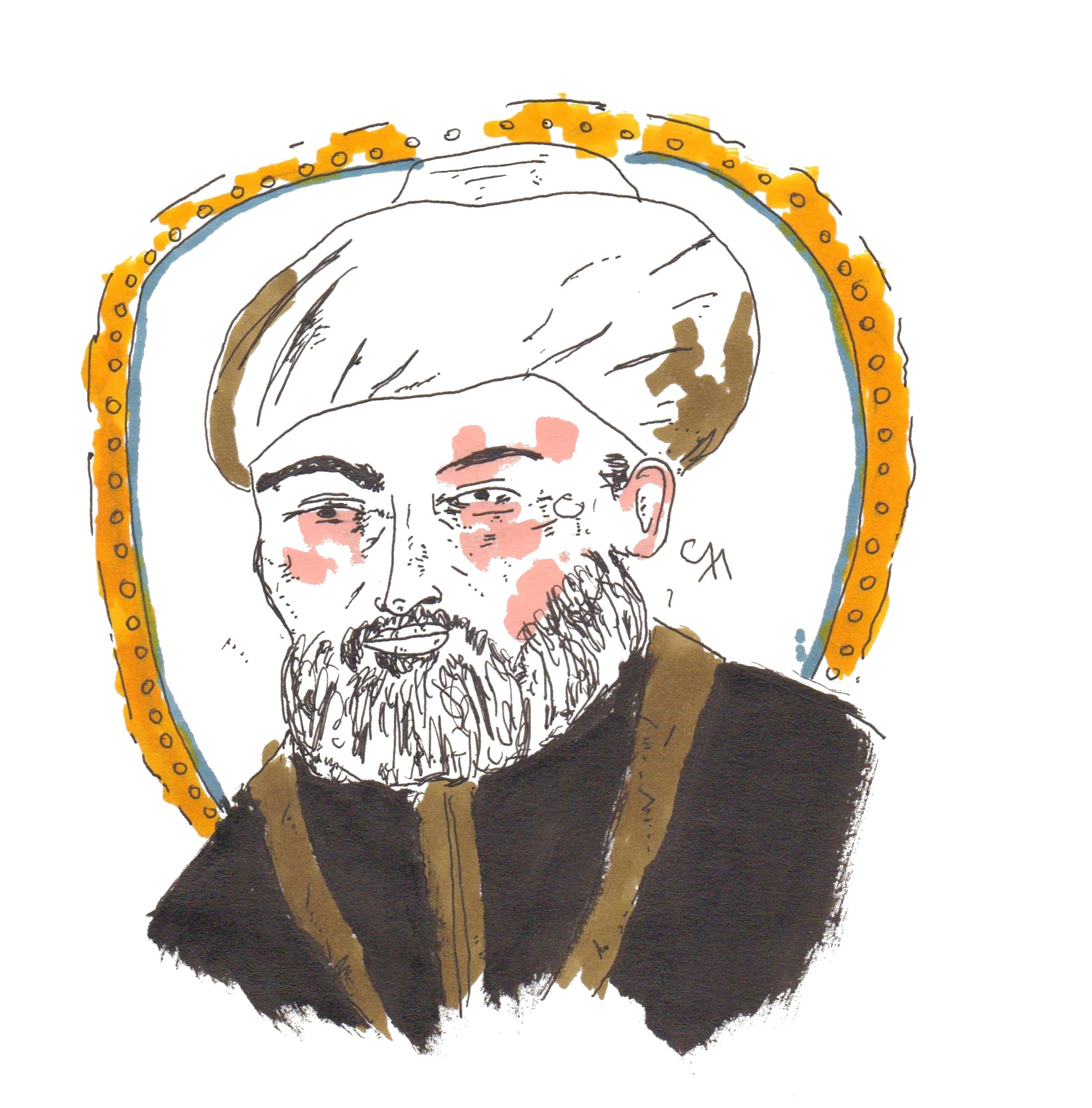
Abraham ben Meir Ibn Ezra (1089 Tudela, Navarre–c.1167) was one of the most distinguished Jewish biblical commentators and philosophers of the Middle Ages.
Abraham Ibn Ezra was born in Tudela, in the present-day Spanish province of Navarre, when the town was under the Muslim rule of the emirs of Zaragoza. Later he lived in Córdoba. In Granada, it is said, he met his future friend (and perhaps his father-in-law) Yehuda Halevi. He left Spain before 1140 to escape persecution of the Jews by the new fanatical regime of the Almohads. He led a life of restless wandering, which took him to North Africa, Egypt (in 1109, maybe in the company of Yehuda Halevi), the Land of Israel, Italy (Rome in 1140–1143, Lucca, Mantua, Verona), Southern France (Narbonne, Béziers), Northern France (Rouen), England (London, and Oxford in 1158), and back again to Narbonne in 1161, until his death on January 23 or 28, 1164, the exact location unknown: maybe at Calahorra at the border of Navarre and Aragon, or maybe in Rome or in the Holy Land. There is a legend that he died in England from a fever and a sickness that came upon him after an encounter with a pack of wild black dogs. This legend is attached to the belief that he denied the existence of demons.
At several of the above-named places, Ibn Ezra remained for some time and developed a rich literary activity. In his native land, he had already gained the reputation of a distinguished poet and thinker but apart from his poems, his works, which were all in the Hebrew language, were written in the second period of his life. With these works, covering the first instance the field of Hebrew philology and Biblical exegesis, he fulfilled the great mission of making accessible to the Jews of Christian Europe the treasures of knowledge enshrined in the works written in Arabic that he had brought with him from Spain.
Ibn Ezra work consist mainly of his commentaries on most of the books of the Bible, of which, however, the Books of Chronicles have been lost. His reputation as an intelligent and acute expounder of the Bible was founded on his commentary on the Torah, of which the great popularity is evidenced by the numerous commentaries that were written upon it. In the editions of this commentary (editio princeps Naples 1488.), the commentary on the Book of Exodus is replaced by a second, more complete commentary of Ibn Ezra, while the first and shorter commentary on Exodus was not printed until 1840. The great editions of the Hebrew Bible with rabbinical commentaries contained also commentaries of Ibn Ezra's on the following books of the Bible: Isaiah, Minor Prophets, Psalms, Job, Torah, Daniel; the commentaries on Proverbs and Ezra–Nehemiah bearing his name are really those of Moses Kimhi. Ibn Ezra wrote a second commentary on Genesis as he had done on Exodus, but this was never finished. There are second commentaries also by him on the Song of Songs, Esther and Daniel.
Ibn Ezra also wrote a commentary on the book of Ecclesiastes. Uncharacteristically of either Ibn Ezra's other commentaries on biblical works, or of Jewish exegesis of the time, the commentary on Ecclesiastes begins with an autobiographical poem (written in the third person) relating his life experience to the material in Ecclesiastes. Although the poem states that he fled "from [my] home in Spain/Going down to Rome with heavy spirit", this does not resolve the question of what intermediate journeys Ibn Ezra may have made before settling in Rome, possibly in the company of R' Yehudah HaLevi.
The importance of the exegesis of Ibn Ezra consists in the fact that it aims at arriving at the simple sense of the text, the Peshat, on grammatical principles. It is in this that, although he takes a great part of his exegetical material from his predecessors, the originality of his mind is everywhere apparent, an originality that displays itself also in the witty and lively language of his commentaries.
Rashbam רשב"ם
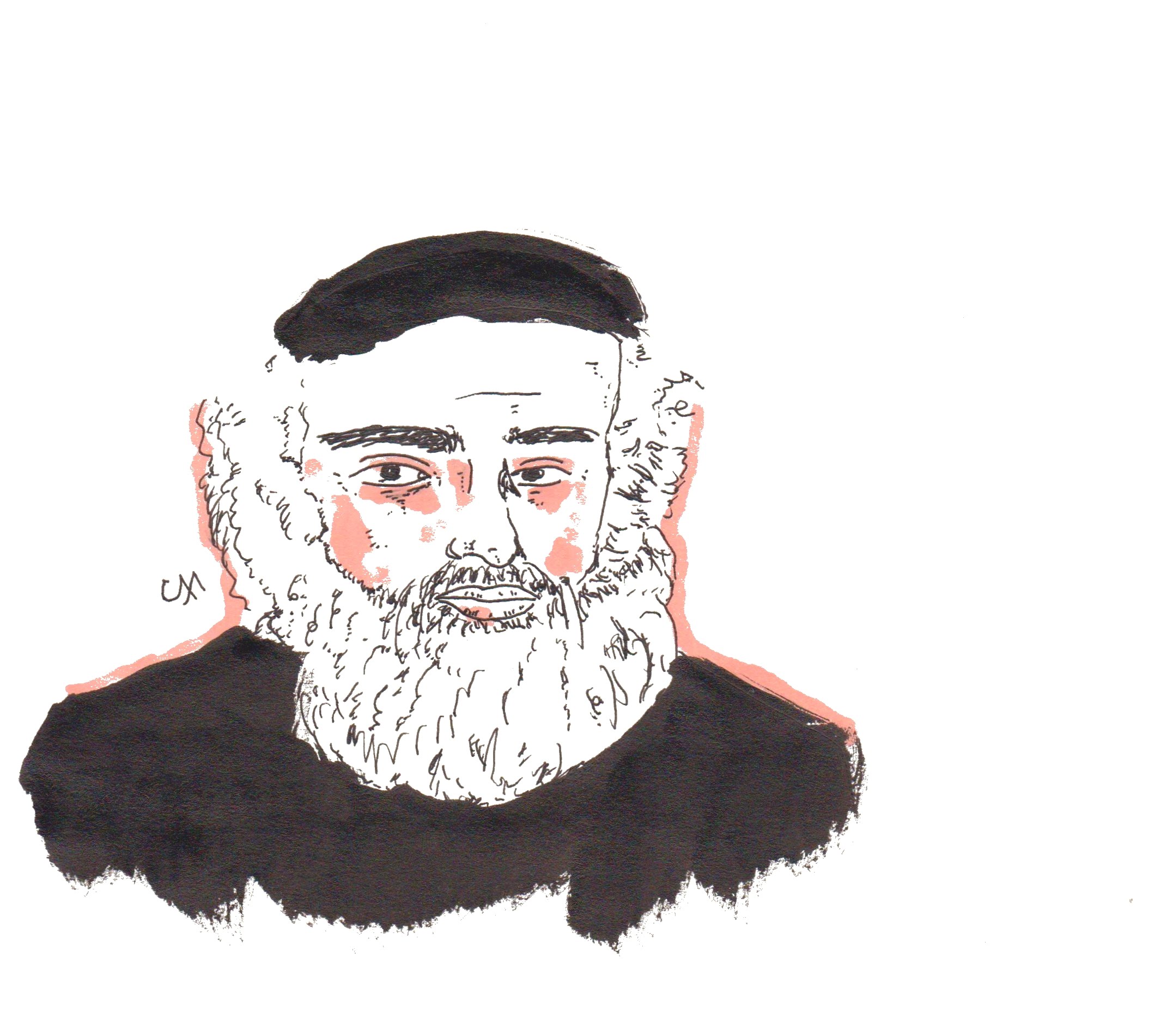
Samuel ben Meir (Troyes, c. 1085 – c. 1158) after his death known as "Rashbam", a Hebrew acronym for: RAbbi SHmuel Ben Meir, was a leading French Tosafist and grandson of Shlomo Yitzhaki, "Rashi."
He was born in the vicinity of Troyes, in around 1085 in France to his father Meir ben Shmuel and mother Yocheved, daughter of Rashi. He was the older brother of the Tosafists Isaac ben Meir (the "Rivam") and Jacob ben Meir ("Rabbeinu Tam"), and a colleague of Rabbi Joseph Kara.
Like his maternal grandfather, the Rashbam was a biblical commentator and Talmudist. He learned from Rashi and from Isaac ben Asher ha-Levi ("Riva"). He was the teacher of his brother, Rabbeinu Tam, and his method of interpretation differed from that of his grandfather.
His commentary on the Torah is renowned for its stress on the plain meaning (peshat) of the text. He sometimes disputes his grandfather's interpretation and indicates that his grandfather concurred with his approach. He adopted a natural (as distinct from a homiletical and traditional) method. This approach often led him to state views that were somewhat controversial. Thus Rashbam (on Genesis 1:5) maintained that the day began at dawn and not from the previous sunset (as later Jewish custom assumed). Another famous interpretation was Rashbam's view that the much disputed phrase in Genesis 49:10 must be rendered “Until he cometh to Shiloh,” and refers to the division of the kingdom of Judah after Solomon's death.
His stance resulted in the omission of his commentary on the first chapters of Genesis in many earlier editions of the Pentateuch. Parts of his commentary on the Talmud have been preserved, and they appear on the pages of most of tractate Bava Batra (where no commentary by Rashi is available), as well as the last chapter of tractate Pesachim. Rashbam's notes on the Bible are remarkable for brevity, but when he comments on the Talmud he is equally noted for prolixity.
Rashbam earned a living by tending livestock and growing grapes, following in his family tradition. Known for his piety, he defended Jewish beliefs in public disputes that had been arranged by church leaders to demonstrate the inferiority of Judaism.
Ramban רמב״ן

Moses ben Nahman (1194–1270), commonly known as Nachmanides (/nækˈmænɪ.diːz/; Greek: Ναχμανίδης Nakhmanídēs), and also referred to by the acronym Ramban /ˌrɑːmˈbɑːn/ (רמב״ן) was a leading medieval Jewish scholar, Sephardic rabbi, philosopher, physician, kabbalist, and biblical commentator. He was raised, studied, and lived for most of his life in Girona, Catalonia. He is also considered to be an important figure in the re-establishment of the Jewish community in Jerusalem following its destruction by the Crusaders in 1099.
Ramban was born in Girona in 1194, where he grew up and studied and died in the Land of Israel about 1270. He was a descendant of Isaac ben Reuben of Barcelona and cousin of Jonah Gerondi (Rabbeinu Yonah). Among his teachers in Talmud were Judah ben Yakar and Nathan ben Meïr of Trinquetaille, and he is said to have been instructed in Kabbalah (Jewish mysticism) by his countryman Azriel of Gerona, who was in turn a disciple of Isaac the Blind.
According to the responsa of Solomon b. Abraham Aderet (part 1, 120, 167) Nachmanides studied medicine. During his teens he began to get a reputation as a learned Jewish scholar. At age 16 he began his writings on Jewish law. In his Milhamot Hashem (Wars of the Lord) he defended Alfasi's decisions against the criticisms of Zerachiah ha-Levi of Girona. These writings reveal a conservative tendency that distinguished his later works — an unbounded respect for the earlier authorities.
In the view of Nachmanides, the wisdom of the rabbis of the Mishnah and Talmud, as well as the Geonim (rabbis of the early medieval era) was unquestionable. Their words were to be neither doubted nor criticized. "We bow," he says, "before them, and even when the reason for their words is not quite evident to us, we submit to them" (Aseifat Zekkenim, commentary on Ketubot). Nachmanides' adherence to the words of the earlier authorities may be due to piety, or the influence of the northern French Jewish school of thought. However, it is thought that it also may be a reaction to the rapid acceptance of Greco-Arabic philosophy among the Jews of Spain and Provence; this occurred soon after the appearance of Maimonides' Guide for the Perplexed. This work gave rise to a tendency to allegorize Biblical narratives, and to downplay the role of miracles. Against this tendency Nachmanides strove, and went to the other extreme, not even allowing the utterances of the immediate disciples of the Geonim to be questioned.
Ovadia ben Jacob Sforno עובדיה ספורנו

Ovadia ben Jacob Sforno was an Italian rabbi, Biblical commentator, philosopher and physician. He was born at Cesena about 1475 and died at Bologna in 1550.
After acquiring in his native town a thorough knowledge of Hebrew, rabbinic literature, mathematics, and philosophy, he went to Rome to study medicine. There his learning won for him a prominent place among scholars; and when Reuchlin was at Rome (1498-1500) and desired to perfect his knowledge of Hebrew literature, Cardinal Domenico Grimani advised him to apply to Obadiah.
Equally high was Obadiah's reputation as a casuist. Meïr Katzenellenbogen consulted him on legal questions (Responsa, p. 97, § 48), and Joseph Colon invoked his authority (Responsa, p. 96, No. 192, Sudilkov, 1834). At the request of Israel ben Jehiel Ashkenazi, rabbi of Rome, Obadiah issued a decision in the case of Donina, daughter of Samuel Ẓdarfati, the renowned physician of the pope. About 1525 Obadiah left Rome and led for some time a wandering life. From several letters of that epoch addressed to his brother Hananeel at Bologna it would appear that Obadiah was in poor circumstances. Finally he settled at Bologna, where he founded a yeshiva (school of advanced Jewish studies) which he conducted until his death.
Obadiah was an indefatigable writer, chiefly in the field of Biblical exegesis. The characteristic features of his exegetical work are respect for the literal meaning of the text and a reluctance to entertain mystical interpretations.
He possessed excellent judgment in the selection of explanations from the earlier exegetes, as Rashi, Abraham ibn Ezra, the Rashbam, and Nahmanides, and he very often gives original interpretations which show an extensive philological knowledge.
He wrote the following commentaries: on the Pentateuch (Venice, 1567); on Canticles and Ecclesiastes, that on the latter being dedicated to King Henry II of France; on the Psalms (1586); "Mishpaṭ Ẓedeḳ," on Job (ib. 1589); on the books of Jonah, Habakkuk, and Zechariah, published with David ibn Hin's "Likkute Shoshannim" (Amsterdam, 1724). He wrote also "Kavanat ha-Torah," prefixed to the Pentateuch commentary.
Obadiah was active also in the domain of religious philosophy. In a work entitled Or Ammim (Bologna, 1537) he endeavored to combat with Biblical arguments the theories of Aristotle on the eternity of matter, on God's omniscience, and on the universality of the soul, as well as various other Aristotelian views that in his view conflicted with religion.
In the introduction Obadiah says that he was induced to write his work by the fact that even so great a man as Maimonides had expressed the opinion that all the theories of Aristotle concerning the sublunary world are absolutely correct. Obadiah himself translated the Or Ammim into Latin and sent it to Henry II of France. It has been published in 1548.
Yehuda Hanassi יהודה הנשיא

Judah ha-Nasi (Hebrew: יהודה הנשיא, Yehudah HaNasi or Judah the Prince) or Judah I, also known as Rabbi (רבי) or Rabbenu HaQadosh (רבנו הקדוש, "our Master, the holy one"), was a second-century rabbi and chief redactor and editor of the Mishnah. He was a key leader of the Jewish community during the Roman occupation of Judea. According to the Talmud he was of the Davidic line, the royal line of David, hence the title nasi "prince". The title nasi was also used for presidents of the Sanhedrin. Judah HaNasi died on 15 Kislev, AM 3978 (around December 1, 217 CE).
According to Rabbinical Jewish tradition, God gave both the Written Law (the Torah) and the Oral law to Moses on Mount Sinai. The Oral law is the oral tradition as relayed by God to Moses and from him, transmitted and taught to the sages (rabbinic leaders) of each subsequent generation.
For centuries, the Torah appeared only as a written text transmitted in parallel with the oral tradition. Fearing that the oral traditions might be forgotten, Judah undertook the mission of consolidating the various opinions into one body of law which became known as the Mishnah. This completed a project which had been mostly clarified and organized by his father and Nathan the Babylonian.
The Mishnah consists of 63 tractates codifying Jewish law, which are the basis of the Talmud. According to Abraham ben David, the Mishnah was compiled by Rabbi Judah the Prince in anno mundi 3949, or the year 500 of the Seleucid era, which corresponds to 189 CE.
Maimonide מֹשֶׁה בֶּן־מַיְמוֹן
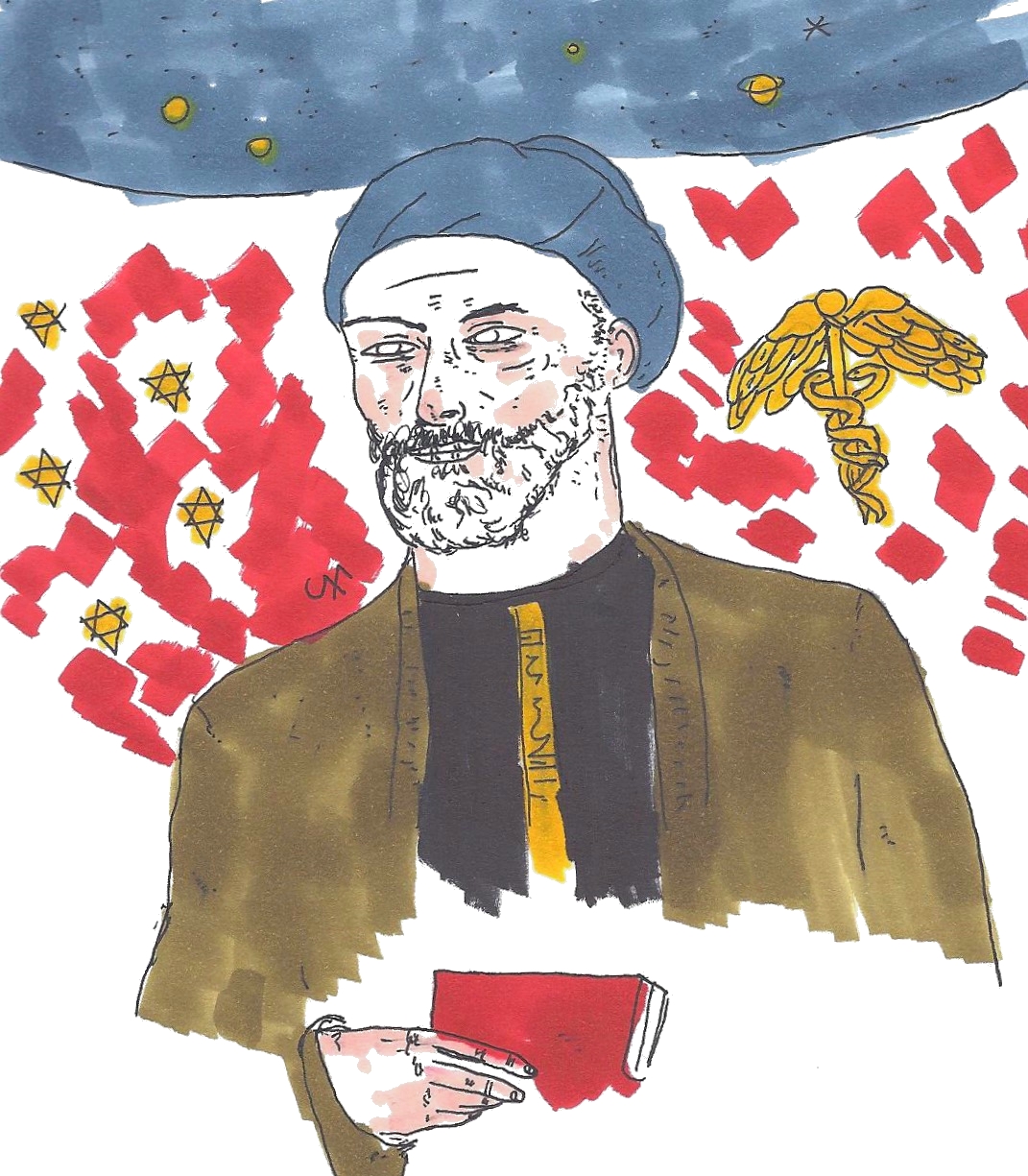
Moses ben Maimon, commonly known as Maimonides, and also referred to by the acronym Rambam (/ˌrɑːmˈbɑːm/; רמב״ם, for Rabbeinu Mōšeh bēn Maimon, "Our Rabbi Moses son of Maimon"), was a medieval Sephardic Jewish philosopher who became one of the most prolific and influential Torah scholars of the Middle Ages. In his time, he was also a preeminent astronomer and physician. Born in Córdoba, Almoravid Empire (present-day Spain) on Passover Eve, 1135 or 1138, he worked as a rabbi, physician, and philosopher in Morocco and Egypt. He died in Egypt on December 12, 1204, whence his body was taken to the lower Galilee and buried in Tiberias.
During his lifetime, most Jews greeted Maimonides' writings on Jewish law and ethics with acclaim and gratitude, even as far away as Iraq and Yemen, and although Maimonides rose to become the revered head of the Jewish community in Egypt, there were also vociferous critics of some of his writings, particularly in Spain. Nonetheless, he was posthumously acknowledged as among the foremost rabbinical arbiters and philosophers in Jewish history, and his copious work comprises a cornerstone of Jewish scholarship. His fourteen-volume Mishneh Torah still carries significant canonical authority as a codification of Talmudic law. He is sometimes known as "ha Nesher ha Gadol" (the great eagle) in recognition of his outstanding status as a bona fide exponent of the Oral Torah.
Aside from being revered by Jewish historians, Maimonides also figures very prominently in the history of Islamic and Arab sciences and is mentioned extensively in studies. Influenced by Al-Farabi, Avicenna, and his contemporary Averroes, he in his turn influenced other prominent Arab and Muslim philosophers and scientists. He became a prominent philosopher and polymath in both the Jewish and Islamic worlds.
Yossef Karo יוסף קארו

Joseph ben Ephraim Karo, also spelled Yosef Caro, or Qaro (1488 – March 24, 1575, 13 Nisan 5335 A.M.), was author of the last great codification of Jewish law, the Shulchan Aruch, which is still authoritative for all Jews pertaining to their respective communities. To this end he is often referred to as HaMechaber (Hebrew: "The Author") and as Maran (Aramaic: "Our Master").
Karo wrote Beth Yosef (בית יוסף), a commentary on Arba'ah Turim, the current work of Jewish law in his days. In this commentary Karo shows an astounding mastery over the Talmud and the legalistic literature of the Middle Ages. He felt called upon to systematize the laws and customs of Judaism in face of the disintegration caused by the Spanish expulsion.
The Shulchan Aruch (שולחן ערוך) is a condensation of his decisions in Beth Yosef. Finished in 1555, this code was published in four parts in 1565. The work was not accepted without protest and criticism, but after the lapse of a century, and in consequence of certain revisions and amplifications, it became the almost unquestioned authority of the whole Jewish world.
Ovadia Yossef עובדיה יוסף

Ovadia Yosef (September 24, 1920 – October 7, 2013) was an Iraqi-born Talmudic scholar, a posek, the Sephardi Chief Rabbi of Israel from 1973 to 1983, and the founder and long-time spiritual leader of Israel's ultra-Orthodox Shas party. Yosef's responsa were highly regarded within Haredi circles, particularly among Mizrahi communities, among whom he was regarded as "the most important living halakhic authority".
On occasion, Yosef made statements relating to various groups and individuals which were deemed controversial by his critics. In response, supporters of Yosef claimed he was misquoted or his words taken out of context.